6 Mistakes Computer Networking Beginners Make That Keep Them From Passing Network+ and CCNA Certifications
NO Admin or Engineer Would DARE Tell You These Things…
Dallas, TX
Hey, I’m Clint Garrett.
I’ve made every mistake in this guide personally. Some of them multiple times.
I started my career working as a retail store cashier in South Texas. Then college. Then tech school. Then two desktop support jobs. In both I experienced layoffs due to company down-sizing.
I also spent my own hard-earned money taking (and failing) multiple certification tests.
Those failures forced me to get serious about what actually helps you learn computer networking: clarity. Since then I became a Network Admin and Senior Enterprise Engineer for almost 23 years, and I’ve helped over 200 other beginners become admins and engineers in the field through the companies I worked for and within Upwork with a Top Rated Plus five star track record.
What follows is everything I learned helping those beginners struggle, learn and succeed.

1. The 2 Study Path Mistakes That Automatically Kill Your Understanding
Mistake #1: If your try to use linear learning by reading straight thru textbooks and material, it means your understanding from the 30,000 Foot View isn’t being built in your mind (aka overview) and the linear method is not helping you see how components and protocols all work together from the top-down on a network.
When it comes to just reading through a textbook or trying to learn linearly, overall understanding is everything and a good overview of networking can double/triple your comprehension.
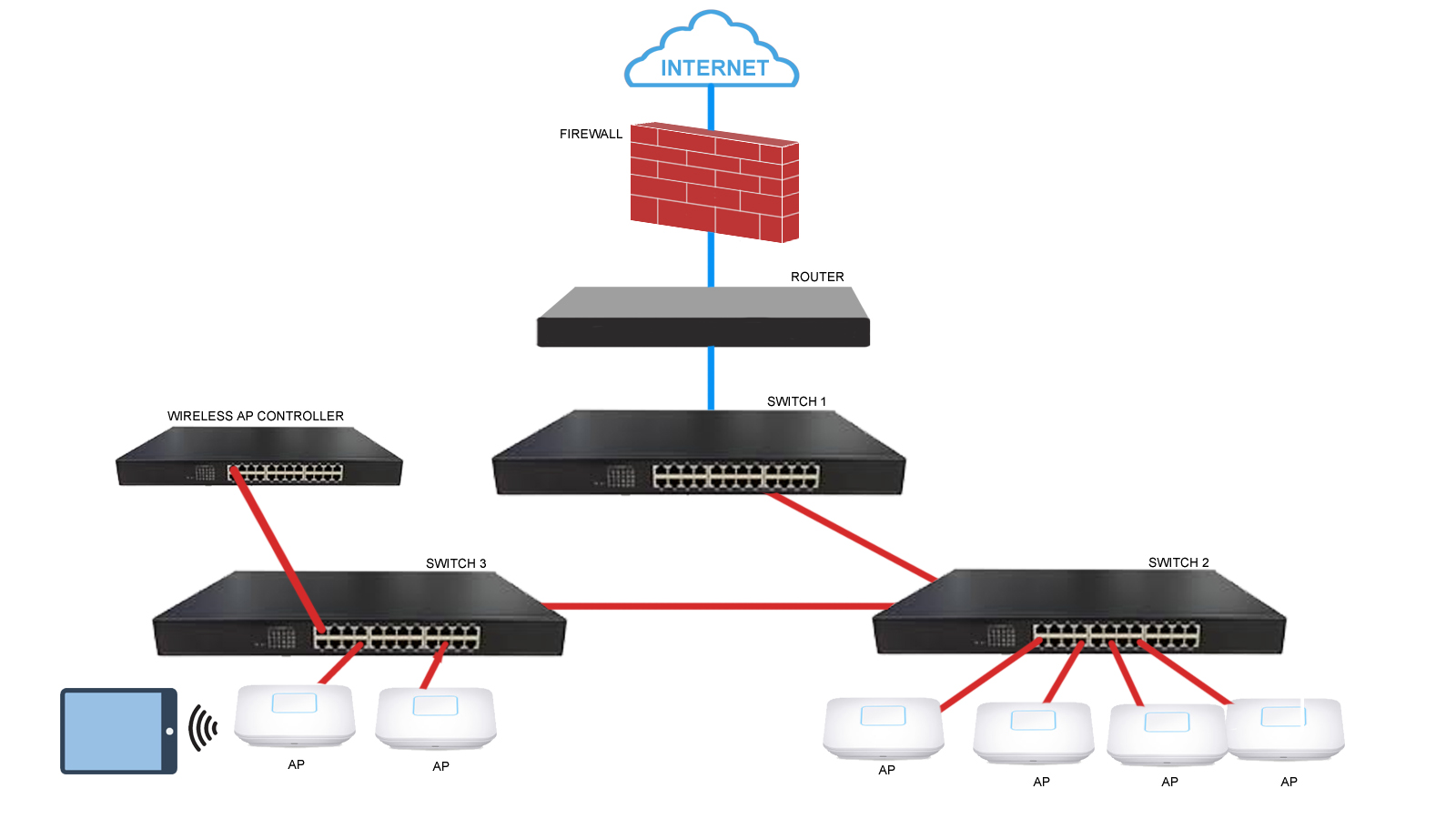
For starters, use a good overview and diagram of a network that uses specificity (devices and components) and/or a vivid overview like this. They almost always work and are easy to implement.
Example:
“To configure a Router, first begin by logging in”
Let’s say I decide to delve into routers to learn them thoroughly. Using that 30,000 Foot View framework, I came up with this:
“Looking at this 30,000 Foot View diagram, let’s look at a few components and how they’re used on a network”
Strong teaching. But it can confuse a beginner, and that’s not what we want.
Mistake #2: Casting too wide of a net.
ONLY learn specifics one thing at a time in tech. By trying to learn everything simultaneously as a beginner, you will end up more confused than when you started.
If you pick one hardware component or one protocol at a time and (beginning with a good 30,000 foot view understanding) you study it thorougly before moving on to something else, you will master it.
Confusing your brain with too much information is far worse than not knowing anything because it creates a false sense of victory and makes you waste and your time and money only to still be confused and overwhelmed.
Too many students of mine thought they were doing great when in fact they were wasting their time and money to try learning it all at the same time. They discovered they really DIDN’T know it, at all.
To filter wasted time, money and effort, you must clearly choose something to learn and what to wait on learning.
Using the same example (notice the addition in brackets) :
“Looking at this 30,000 Foot View diagram, [let’s first discuss how the Router is connected and talk about why it’s used and how it’s used on a network]”
The specificity ensures we are thoroughly learning about something individually. An important distinction if you’re wanting to learn fast in tech (and especially in computer networking).
Additionally, if you want to remember what you learn, add a time filter in your plan:
“I’m going to learn this in 2 days before I move on to something else”
The end result:
Looking at this 30,000 Foot View diagram, [let’s first discuss how the Router is connected and talk about why it’s used and how it’s used on a network]
“I’m going to learn this in 2 days before I move on to something else”
The lesson: methodology is everything.
A great overview plan of “attack” speeds your learning and understanding, filters out the wasted time, money and resources, and makes comprehension feel like a no-brainer. That’s three jobs in one short period of time.
2. Being Lazy With Your Learning Guarantees Near-To-Zero Understanding or Advancement
As of 2025, it’s now harder than ever to grasp everything in tech, and especially in computer networking (with AI beginning its use in the field). The computer networking industry is now plagued by weak applicants, job fatigue, competition, and AI.
The need for qualified experts providing UNIQUE skills and abilities is bigger than ever.
So don’t float around yet another lame study path, rely on recycled YouTube videos and AI-regurgitated content.
It’s lazy and signals your potential to companies and industries that need experts in the field that you’re not worth their attention.
Even if you manage to get them to hire you, you’ll lose their faith (and probably your job) immediately once they realize you don’t really know what you’re doing or their networks go down or get hacked and you can’t troubleshoot them.
I don’t care how good your “course” or “study plan” is, AI has no soul (at least now) and can’t conjure unique or qualifiable content, let alone good training which is essential in your success in the computer networking industry.
Instead, your knowledge, expertise and skills should be something they’re willing to pay for and can’t find anywhere else.
This doesn’t need to be 4 years of study, actual work experience or a college degree. It could be ONE 30,000 Foot Overview and study plan.
But…
It needs to elevate your knowledge and understanding. They need to feel they acquired an employee or contractor that can only come from pure expertise.
Not AI.
(btw, I use AI all the time and I’m a big proponent of it but “unique insight” can only be “unique” if it was acquired by and lived by you and you alone)
So spend the time and money to do something good…the RIGHT way.
For example, this list of Top 6 Reasons is the result of hundreds of hours fixing my students’ study and learning paths. These reasons have been battle-tested with years of training beginners across various industries and companies.
I, and my students spent lots of our money and time to test these things.
All yours for free here.
It will prevent you from forcing yourself, your inexperience and your lack of understanding down a company’s throat and never making any progress in the actual field of computer networking.
Do the same with your own study and understanding.
With one caveat: do not over-study. Learn what one component or protocols does and is, not how it intricately works at every level from the inside-out.
You need to see how it all fits together OVERALL first, but not every detail of everything all at once.
Otherwise, you won’t be any good in the field of computer networking.
3. Why Skipping This Tactic Is Making Expertise In Networking Impossible (and how to fix it)
Even if your knowledge and expertise is exactly what they needed and you managed to get a college degree, that alone won’t make them hire you (or not fire you if they mistakenly hired you to begin with).
They will probably try you out, watch you, wait for you to make a mistake, but then let you go.
No long-term career or experience (or Certifications) that you can show them.
And that’s not an employer or industry problem.
It’s simpler than that.
There’s no reason for them to trust you with their network.
And when there’s no reason to hire you or keep you on, people don’t.
Ever.
That fact is even more true with companies that mistakenly hire posers where there is no “built-in” experience or knowledge of what is actually going on and how things actually work.
You can always hire another person “later.”
Take a side company course when they’re “more ready” to try figuring it out themselves.
Invest in good external experts when they have “more money.”
There are certifications in computer networking like healthcare professionals or emergency personnel.
So if you want your expertise to convert companies or hiring managers, tell them why they need to hire or pay you now by at least getting your certifications.
Otherwise they’ll be on your list for a long time before they hire you or pay you any money to work on their network.
There are multiple ways to get those certifications depending on your career/business path but the most popular are good study paths (that work) and allow you to show THEM you know what you’re doing.
Do not use weak career or business intros such as: ”if you need help with X, I’m knowledgeable”.
This gets ignored like a legal disclaimer at the bottom of a page.
Instead, a good career or business path (acquired with certifications you have) could look like this:
“How much is not having an expert on-hand worth to you annually? Whatever that number is, my expertise costs a fraction of it.
Think about how long you’ve been needing a network expert onsite. Every month you wait or try to figure it out yourself is a month of costs and problems you won’t get back. At $65K/year, my expertise is the cheapest business decision you’ll make all year.
If for any reason you are not thrilled with the expertise I provide you, you can find someone else without any questions.
One thing: I will increase my pricing soon because my expertise is growing and as demand grows for qualified individuals in the field I’ll be raising my requested salary to reflect that.
So, if you’re done figuring this out alone, let’s talk more before I get hired by someone else”
A warning: hiring managers can smell manufactured scarcity.
Whatever “sales pressure” you use, make sure it’s real and you can back it up WITH good certifications.
Otherwise you’ll lose all credibility.
4. Overwhelm With Where To Actually START Becomes a Crutch
For beginners, the #1 pain point isn’t so much the complexity of networking—it’s overwhelm + fear of not being able to “get it”.
- They don’t know where to start…
- Do I learn IP addressing?
- Do I learn Routing?
- Do I need to learn switches first?
- They’re terrified of the jargon…
- What is CIDR notation?
- What is subnetting? Why do we use it or need it?
- Why do I need to know the OSI Model?
- They don’t see how theory connects to real-world application…
- “How will this ever help me get a job?”
- They’re afraid they’ll waste time on courses that are either too advanced or too basic.
So the core pain that most beginners feel is one of the biggest set-backs to learning about computer networking
“Networking feels overwhelming, I don’t know what to focus on, and I’m afraid I’ll never actually ‘get it’ enough to apply it in the real world.”
You need a simplified overview that shows you where to begin, what each of these topics are (what, why, how they are used, etc.)
If you aren’t shown all of this correctly, you’ll quickly burn out not knowing where to start or where to go from “here” (wherever “here” is).
Otherwise, you may quit before you succeed in the field.
5. It Seems Counterintuitive: But You Need to Learn Networking From The Top Down
The goal of your learning computer networking is to get you into a career or business of your own that pays lots of money.
Yes you’ll provide value, but ultimately, your knowledge and understanding will GET YOU PLACES.
And for companies and businesses to hire you, they need to see that you’re qualified.
There are multiple ways to do this but two that I like are:
Overall Understanding of Computer Networks: If you don’t understand how networks work overall and you don’t understand why they’re needed and what they do, it will take you forever to get anywhere in the field.
“If your knowledge and expertise is only so-so, you’re not just losing opportunities. You’re wasting your time and missing out on getting paid really good money.
It’s not a qualification problem.
It’s not the industry or those teaching it (per se).
It’s your method of learning.
Experts that know how to fix this have simplified methods of learning that work to make it easy. Book a call by clicking the link below if you want to be one of them.
https://acenetworker.com/calendar
“There’s a specific mistake most beginners make that undoes everything else and makes this topic so difficult to understand.”
“It’s everywhere and too specific to each beginner to cover here. But it’s the first thing I look at on every new student that joins.”
Once you understand networking from the 30,000 foot view, you’ll never find it hard or complicated or complex again.
The better and faster you are at learning it, the more opportunities (and advancement) you’re gonna get.
6. The One Thing That Will Protect You From Overwhelm
Everything we’ve covered matters.
But this one might matter most.
Divide and Conquer.
All networks are based on basic concepts.
There’s a line that’s stuck with me: “Divide and rule, you see. Why should we change now when it’s worked so well?”
Most I/T networking textbooks and courses read like they were written by an AI or an expert that’s talking over our heads (especially as beginners).
No voice, no opinion, no flaws, no humanity. No methodology for learning it the simple way. The easy way.
There’s nothing that differentiates them from any other textbook.
And there is enough free information online. But it’s hard to know where to start.
That’s why AI isn’t close to replacing humans when it comes to learning computer networking.
It just can’t do it.
Even if you give AI the perfect prompt.
It can’t dig into your memory and see your experiences, read your emotions, understand context and nuance, or know your unique vantage point to learning something in the most simple way.
The same can be said about your other options for learning networking.
They can’t be you or understand you and therefore can’t help but confuse you if you plow too fast headlong into them.
If you don’t divide and conquer the concepts of networking into hardware components and protocols (software and configuration) and show how they all relate to and work with each other, it will almost always confuse you and frustrate you.
Dividing and conquering is your only advantage against AI and all the other material out there.
Plus, whatever you read or open, dividing and conquering logically will make it so much easier to understand and see how it all works together.
Again, people want to learn as quickly and easily as possible.
See the story I shared in the introduction of this document?
That’s what should show you that I know what DOESN’T work…or what takes entirely too long to get you to the expert level you need to be. As quickly as possible.
And people learn from simplified concepts.
You should do the same with your own computer networking knowledge.
I can’t stress this enough.
Your next move…
These aren’t every mistake computer networking beginners make.
There are more. Some too industry-specific, others too nuanced to cover here.
But here’s the thing…knowing these mistakes is only half the battle.
Figuring out which ones apply to your specific situation as a beginner in computer networking, in what order to fix them, and how to implement them correctly?
That’s where most people get stuck.
Where you lose another month (or 6 months or more) tweaking and trying different things on your own.
Another 3-6 months of expertise and personal advancement toward success you won’t get back.
That’s exactly what the ‘Ace Startup’ Intro is for.
In a 30 minute call I’ll go through your 30,000 Foot View overview of computer networks, tell you exactly what each item is and what to learn first.
What took you weeks to learn here takes just 30 minutes to apply to your career path specifically.
Book your call by clicking the button below.
The more you delay, the more it costs you.